
Flying With a Mobility Scooter
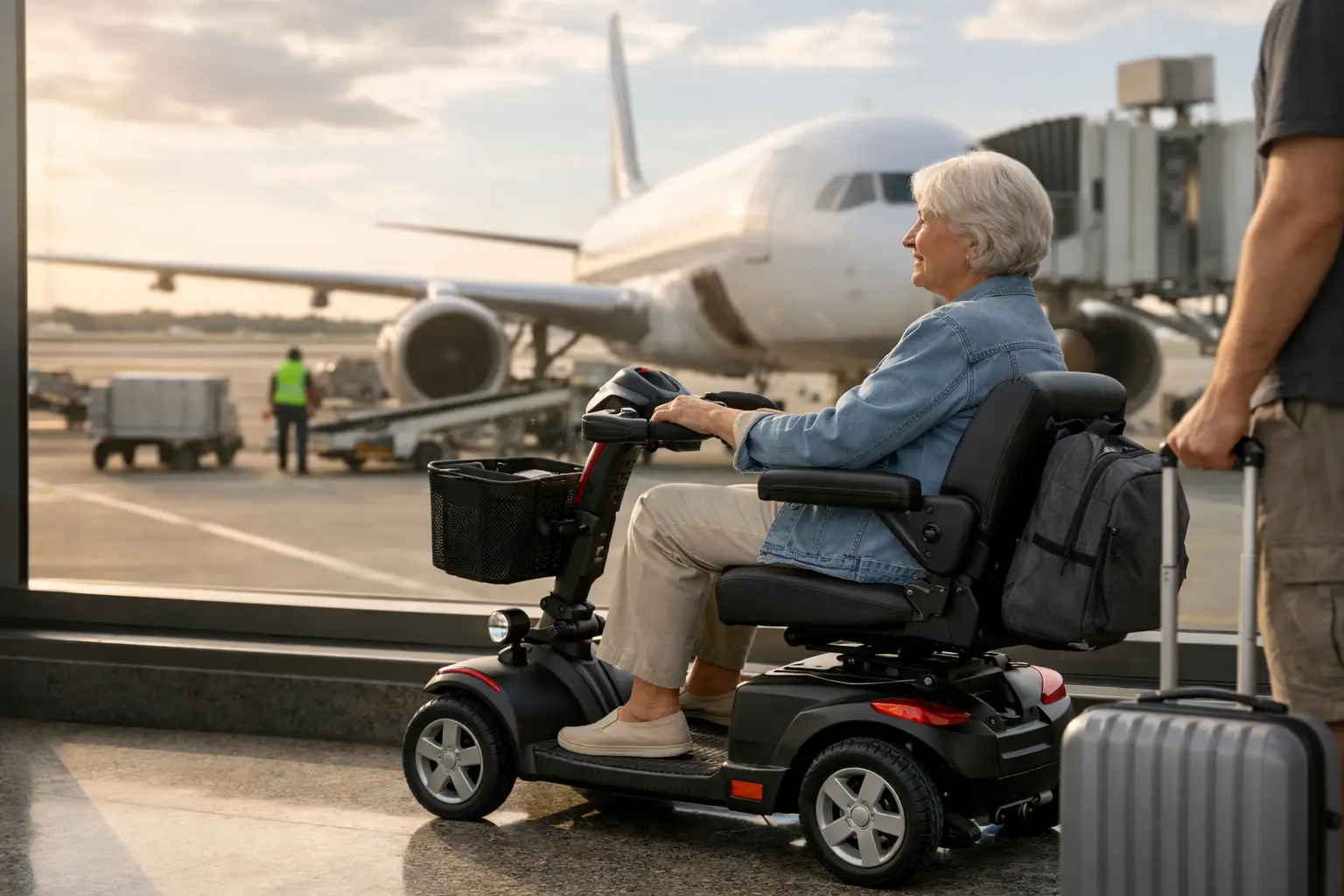
Air travel can go wrong for anyone, but flying with a mobility scooter adds a layer of stress you should not have to guess your way through. The good news is that it is absolutely doable. The less cheerful truth is that airlines, airports and ground staff do not always handle scooters well unless you prepare properly and make your needs very clear from the start.
If you use your scooter to stay independent, the aim is not simply getting on the plane. It is getting through the whole journey with your equipment accepted, protected and ready to use at the other end. That means understanding battery rules, asking the right questions before you book, and not assuming the person on the phone knows the difference between a folding travel scooter and a large road scooter.
Please watch these videos in the series Trains, Planes and Automobiles playlist on YouTube.
Flying with a mobility scooter starts before you book
The biggest mistake people make is choosing flights on price alone and dealing with the scooter later. That can work for hand luggage. It is a poor strategy for mobility equipment.
Start with the scooter itself. Check the total weight, whether the battery is lithium or sealed lead acid, whether the battery can be removed, and whether the scooter folds or breaks down into parts. You need the manufacturer specifications in writing, ideally as a PDF or product sheet, which you can send to the airline if needed. Do not rely on memory, and do not expect airline staff to understand vague descriptions like “a small one” or “a boot scooter”.
Then check the airline’s mobility equipment policy before booking. Not every airline handles scooters in the same way, and some have tighter battery limits than others. The key issue is often the battery rather than the scooter frame. If the scooter has a lithium battery, the airline may ask for watt-hour details and confirmation that the battery is approved for carriage. If it uses sealed lead acid or gel batteries, the rules are often more straightforward, but you still need the exact type confirmed.
This is also the point to think about aircraft type and route. A larger long-haul aircraft may offer more flexibility than a smaller short-haul plane with tighter hold space. Sometimes the route matters as much as the airline. A direct flight is usually the safest option because every transfer creates another opportunity for delay, confusion or damage.
What to ask the airline
When you contact the airline, do not just say you are travelling with a mobility scooter. Give them the full dimensions, weight and battery type straight away. Ask them to add it to the booking and send a written confirmation.
You want clear answers on a few things. First, whether your scooter is accepted on that route and aircraft. Second, whether the battery needs to be removed for the flight. Third, whether you can stay in your own scooter until the departure gate or whether it must be handed over earlier. Fourth, what support is available between check-in, security, boarding and arrival.
If the airline says “it should be fine”, push for something firmer. “Should be” is not enough when your independence depends on that scooter turning up safely.
Battery rules are where most of the confusion sits
Battery rules can sound more intimidating than they need to be, but this is the part you must get right. Airlines and airports are especially cautious about lithium batteries, and rightly so.
If your scooter has a lithium battery, check the watt-hour rating on the battery label or manufacturer paperwork. Some airlines accept removable lithium batteries only up to a certain limit, and they may require the battery to travel in the cabin rather than the hold. Others may accept installed batteries under specific conditions. It depends on the airline, the battery size and whether it is securely attached.
If your scooter has sealed lead acid, AGM or gel batteries, the process can be simpler, though the airline may still want confirmation that the battery is non-spillable. This is where written documentation helps enormously.
Do not turn up hoping airport staff will sort it out. If battery details are missing or unclear, your scooter may be refused. That is not alarmist. It happens.
Prepare the scooter for handling, not just for travel
Airlines usually carry mobility scooters free of charge, but free does not mean careful. Ground crews are working fast, often under pressure, and your scooter may be handled by several different people who know nothing about it.
Before travel, take photos of the scooter from all angles. Photograph the condition, controls, tiller, armrests, basket and any detachable parts. If there is any damage later, those photos matter.
Label the scooter clearly with your name, phone number, flight details and destination address if relevant. Add simple handling instructions in plain language, such as where to lift, whether it folds, how to disengage freewheel mode, and whether the battery must stay upright. Laminated instructions attached to the scooter can save a lot of trouble.
Remove loose accessories if you can. Baskets, cushions, mirrors, cup holders and oxygen bag clips can disappear or get snapped off. If the battery is removable and must come out, carry it exactly as instructed by the airline. If the key can be removed, take it with you.
It is also worth carrying a basic toolkit or any scooter-specific parts you might need after reassembly, as long as they are permitted in your baggage. A loose knob or missing pin can turn a workable arrival into a miserable one.
At the airport, allow more time than you think
Flying with a mobility scooter is rarely quick through the airport, even when everything goes well. Extra time gives you breathing space and reduces the pressure if a member of staff needs to check battery paperwork or call a supervisor.
Arrive early and go to a staffed check-in desk rather than relying on self-service. Make sure the scooter is properly recorded and ask again when it will be taken from you. In many cases, you can stay on it until the gate, which is usually the best option. It keeps you comfortable and reduces transfers into airport wheelchairs.
Airport assistance can be very good, average or poor. Sometimes the issue is not a lack of goodwill but a lack of clear communication. Tell staff exactly what you need. If you cannot self-transfer, say so. If you need an aisle chair, ask in good time. If your scooter breaks down into parts, make sure they know all parts need to travel together.
Security can take longer too. That does not mean it will be a problem, but it may be more hands-on and less familiar to staff than a standard passenger screening.
Boarding and arrival are often the weak points
Boarding can feel rushed, and that is where details get missed. If you are gate-checking the scooter, remind staff that it is mobility equipment and confirm the instructions attached to it. If there are detachable parts, point them out directly.
On arrival, do not assume your scooter will be waiting at the aircraft door even if that was the plan. Sometimes it appears there. Sometimes it goes to oversized baggage. Sometimes, nobody seems sure. This is one of the most frustrating parts of accessible flying.
Stay calm but be firm. If the scooter is delayed, ask staff to track it immediately and provide suitable assistance while you wait. If there is damage, report it before leaving the airport. Take photos straight away and insist the issue is logged formally. Temporary repairs might get you through the holiday, but you still need a proper record from day one.
Practical trade-offs to think about
A lighter folding scooter is often easier for air travel than a larger, heavier model. That is the obvious upside. The downside is that a travel scooter may be less comfortable over long distances at your destination, especially outdoors on rough surfaces.
A direct flight reduces handling risk, but it may cost more or limit your timing options. Paying extra can be worth it if it cuts out a connection and one more baggage transfer.
Hiring a scooter at the destination sounds easier on paper, but the quality and suitability can vary massively. If your own scooter fits you properly and you rely on it every day, taking your own is often the better option - provided the airline accepts it and you have prepared properly.
A simple checklist for peace of mind
You do not need a complicated system, but you do need consistency. Before you travel, make sure you have:
- the scooter’s dimensions, weight and battery details
- written airline approval
- any battery paperwork or manufacturer documents
- photos of the scooter before departure
- handling instructions attached to the scooter
- removable parts packed safely
- Airport assistance is added to the booking
- A plan for what happens if the scooter is delayed or damaged
That last point matters more than many people realise. Think ahead about medication, walking limits, transfer needs and whether someone travelling with you can help if the scooter does not appear when it should.
For disabled travellers, confidence rarely comes from glossy promises. It comes from knowing the weak points in the journey and preparing for them properly. That is the difference between hoping for a smooth trip and giving yourself the best possible chance of one.
If flying has felt out of reach because of your scooter, do not let poor information make the decision for you. Ask harder questions, get everything in writing, and back your own experience. The system is not always built with us in mind, but that does not mean we have to stay grounded.